The Krevie Journal
This older article has been removed because the routine has been updated to Foundation + Creatine Companion.
Read moreWhy 28 mg standardised saffron extract: the crocin and safranal question
The dose of saffron that has been studied in perimenopausal women is 28 mg of saffron extract per day. 22 mg did not reach significance in the same trial framework. Here is why standardisation matt...
Read moreCiticoline vs choline: what's actually different
Choline is a nutrient. Citicoline is a compound that the body converts from choline. CDP-choline is a branded, clinically-studied form of citicoline. Here is how the three relate.
Read moreFrench maritime pine bark research: what 30 years of studies actually show
French maritime pine bark extract — French Maritime Pine Bark Extract — has been the subject of peer-reviewed research for more than three decades. A look at what the major studies in perimenopausa...
Read moreWhich nutrients does research link to cognitive changes in perimenopause?
A look at what the clinical research actually measured — citicoline, creatine HCl, French maritime pine bark extract, saffron, B vitamins, omega-3 — and the trial populations, doses and durations b...
Read moreHow long should a perimenopause supplement take to work?
Most perimenopause supplement research runs 8–12 weeks. That is the evidence window for measuring an effect. If you are on week 4 or 8 with no reference point, you are not alone.
Read moreMenopause supplement ingredients to avoid: red flags, proprietary blends, and underdosing
A consumer-education guide to the three main reasons menopause supplements do not deliver: proprietary blends that hide dose, underdosed ingredients, and unauthorised health claims. How to spot eac...
Read moreVitamin D3 dose: why 2,000 IU, not 5,000
The NHS recommends 400 IU. Some wellness sources push 5,000 IU. The research dose-response data shows the meaningful response plateau sits in the 1,500–2,000 IU range. Here is what the evidence say...
Read more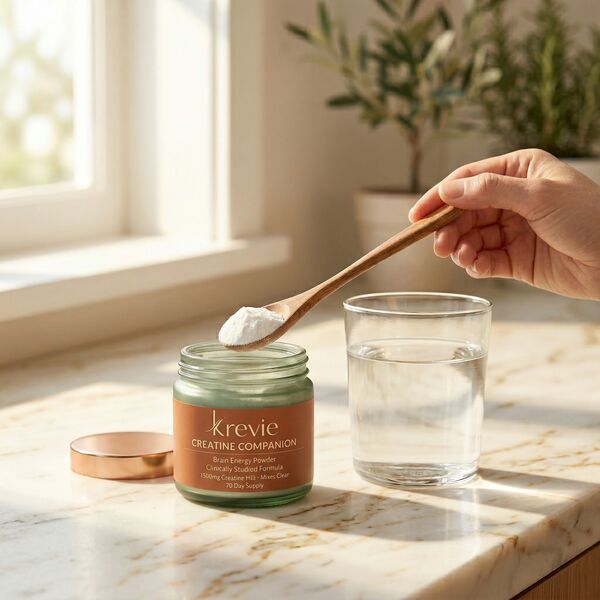
Creatine HCl vs monohydrate: what the CONCRET-MENOPA trial actually measured
The first RCT testing creatine HCl at 1,500 mg specifically in perimenopausal and menopausal women — what Korovljev et al. 2025/2026 measured, why the dose is not 5 g, and what the water-retention ...
Read more
Why most menopause supplements are incomplete
Most supplements in this category fail on one of two points: an unproven ingredient at any dose, or a researched ingredient at a fraction of the research dose. A breakdown of the fairy-dust problem...
Read more