Why most menopause supplements are incomplete
Three common failure patterns in this product category
Failure pattern 1: The botanical-only formula
A large proportion of menopause supplements are structured around one or two botanicals — typically black cohosh or red clover isoflavones — at the expense of everything else. The evidence for black cohosh is genuinely mixed: a Cochrane systematic review of 16 RCTs in 2,027 women concluded there was "insufficient evidence to support the use of black cohosh for menopausal symptoms" compared to placebo. (Leach & Moore, Cochrane, 2012) More recent reviews have found a signal in better-standardised isopropanolic extracts at 40 mg/day, but the evidence is extract-specific and dose-dependent — and most products using "black cohosh extract" provide neither the specific extract nor a verified dose.
For red clover isoflavones, a 2021 meta-analysis by Kanadys et al. in Nutrients pooled 8 RCTs and found a modest, statistically significant reduction in vasomotor frequency compared to placebo (WMD −1.73 per day, p = 0.0292) — but only in analyses showing ≥80 mg/day isoflavones for ≥12 weeks, with 87.34% heterogeneity across studies. (Kanadys et al., 2021 — Nutrients, PMID 33920485) A product providing red clover isoflavones below 80 mg/day or inside an unverified blend cannot claim to replicate those conditions.
The deeper problem: even where these botanicals have published evidence, that evidence addresses one dimension of what is happening in this life stage. A formula that is only a botanical formula has made no provision for the cognitive and structural dimensions that the research increasingly shows are addressable with different ingredients.
Failure pattern 2: B-complex over-reliance
B vitamins are the cultural default for "brain support". They are so embedded in general nutritional advice that many multi-ingredient formulas in this category include a substantial B-complex — B6, B12, folate, biotin — as a proxy for cognitive support. This is not without basis: B-vitamin deficiency can impair neurological function, and older adults are at higher risk of B12 insufficiency. However, there is no meaningful published evidence that B-vitamin supplementation, in the absence of a diagnosed deficiency, produces measurable cognitive outcomes in perimenopausal or post-menopausal women who are not deficient to begin with.
The perimenopause-specific cognitive research points in a different direction: creatine hydrochloride, citicoline (CDP-choline), French maritime pine bark extract, and saffron extract each have double-blind, placebo-controlled RCT evidence for measurable outcomes in relevant populations. B vitamins, consumed on top of an adequate dietary intake, do not. A formula built around B-complex supplementation as its cognitive support strategy is using general population nutritional logic where perimenopause-specific trial evidence exists and has been ignored.
This matters because space in a capsule is finite. Every milligram allocated to a B-complex at NRV doses is a milligram not allocated to an ingredient with evidence in this specific context.
Failure pattern 3: The large-blend, all-the-ingredients approach
The formula contains 15–20 ingredients, all mentioned in some context in the literature, in a two-capsule daily serving. The ingredient list is impressive. The arithmetic makes it functionally impossible. A standard HPMC capsule holds approximately 500 mg of material. Two capsules provide roughly 1,000 mg total for all ingredients combined, minus capsule shell weight. citicoline (CDP-choline) at its research dose alone (500 mg) would consume the entire serving. Including 15 further ingredients at meaningful doses is not physically achievable in this format.
What these products invariably do is either use proprietary blends to hide the dose distribution, or disclose individual doses that are fractions of the studied amounts. The label looks comprehensive. The formula is structured around label aesthetics, not research replication. The buyer pays for the names on the label and receives doses that bear no mechanistic relationship to what those ingredients have been shown to do.
What the research says each key ingredient actually requires
| Ingredient | Research dose | Typical multi-ingredient product dose | Primary trial |
|---|---|---|---|
| citicoline (CDP-choline) | 500 mg/day | 50–100 mg (often in blend) | Nakazaki et al., 2021 — J Nutr (PMID 33978188) |
| Creatine HCl | 1,500 mg/day | Absent from most menopause supplements | Korovljev et al., 2026 — CONCRET-MENOPA (PMID 40854087) |
| French maritime pine bark extract | 150–200 mg/day | 30–60 mg (often in blend) | Belcaro et al., 2014 — J Neurosurg Sci (PMID 24675223) |
| saffron extract | 28 mg/day | Variable; often unstandardised and in blend | Kell et al., 2017 — Complement Ther Med (PMID 28735826) |
| Red clover isoflavones | ≥80 mg/day for ≥12 weeks | 40–60 mg (frequently below threshold) | Kanadys et al., 2021 — Nutrients (PMID 33920485) |
| Vitamin D3 | 1,000–2,000 IU/day | Often 200–400 IU (NRV reference only) | NHS supplementation guidance; NDNS prevalence data |
The cognitive support gap: why most formulas ignore the strongest evidence
The most striking gap in this product category is the near-total absence of creatine hydrochloride at the dose and form studied in perimenopausal and menopausal women. The CONCRET-MENOPA trial by Korovljev et al. (2025/2026, published in Journal of the American Nutrition Association, PMID 40854087) was a double-blind, placebo-controlled RCT in 36 perimenopausal and menopausal women, 8 weeks in duration. The medium-dose creatine HCl group (1,500 mg/day) showed a 6.6% improvement in reaction time versus 1.2% in the placebo group (p < 0.01) and a 16.4% increase in frontal brain creatine concentrations versus 0.9% in placebo (p < 0.01). (Korovljev et al., 2026 — J Am Nutr Assoc, PMID 40854087)
Creatine is not a botanical and it does not fit the "hormonal balance" narrative that organises most of this category's marketing. It is not traditionally associated with "women's health" supplementation in the cultural imagination. These are the reasons it is absent from the category — not scientific ones. The trial evidence for creatine HCl at 1,500 mg/day in this population is more recently published and more directly relevant than the evidence for most of the ingredients that do appear in these formulas.
Similarly, citicoline (CDP-choline) at 500 mg/day has direct published RCT evidence for episodic and composite memory in 100 healthy adults aged 50–85 (Nakazaki et al., 2021). French maritime pine bark extract at 150–200 mg/day has cognitive and oxidative stress evidence in working-age and older adults (Belcaro et al., 2014). saffron extract at 28 mg/day has the largest saffron RCT in adults to date (n = 202, 12 weeks, p = 0.010 for improvement on the validated mood rating scale used in the trial) confirming the dose established in the 2017 Kell et al. trial. (J Nutr, 2025, PMID 40414301)
None of these are present in the majority of commercial menopause supplements at their research doses. The market is structured around a different set of priorities.
The claims problem: what "clinically studied" actually means
Many products in this category carry the language "clinically studied ingredients" or "research-backed formula." These phrases are unregulated and have become nearly meaningless. "Clinically studied" means only that some trial, somewhere, studied that ingredient in some population at some dose. It does not mean:
- The product uses the specific extract or form that was studied
- The product uses the same dose as the trial
- The population in the trial resembles the product's target buyer
- The trial showed a positive result
Under the UK's retained Nutrition and Health Claims Regulation (EC 1924/2006), health claims on food supplements must be authorised claims from the UK register. "Clinically studied" is not an authorised claim — it is marketing language with no regulatory definition. Generic hormonal-support phrasing is not an authorised claim. "Natural menopause support" is not an authorised claim. When you see these phrases, the right response is to look past the marketing copy and directly at the Supplement Facts panel — and then to check the dose arithmetic.
How Krevie approaches this
Krevie's position is simple: dose = research dose, always. Not 10% of it to fit a price point. Not in a blend where the actual amount cannot be verified. The exact dose from the most relevant published trial.
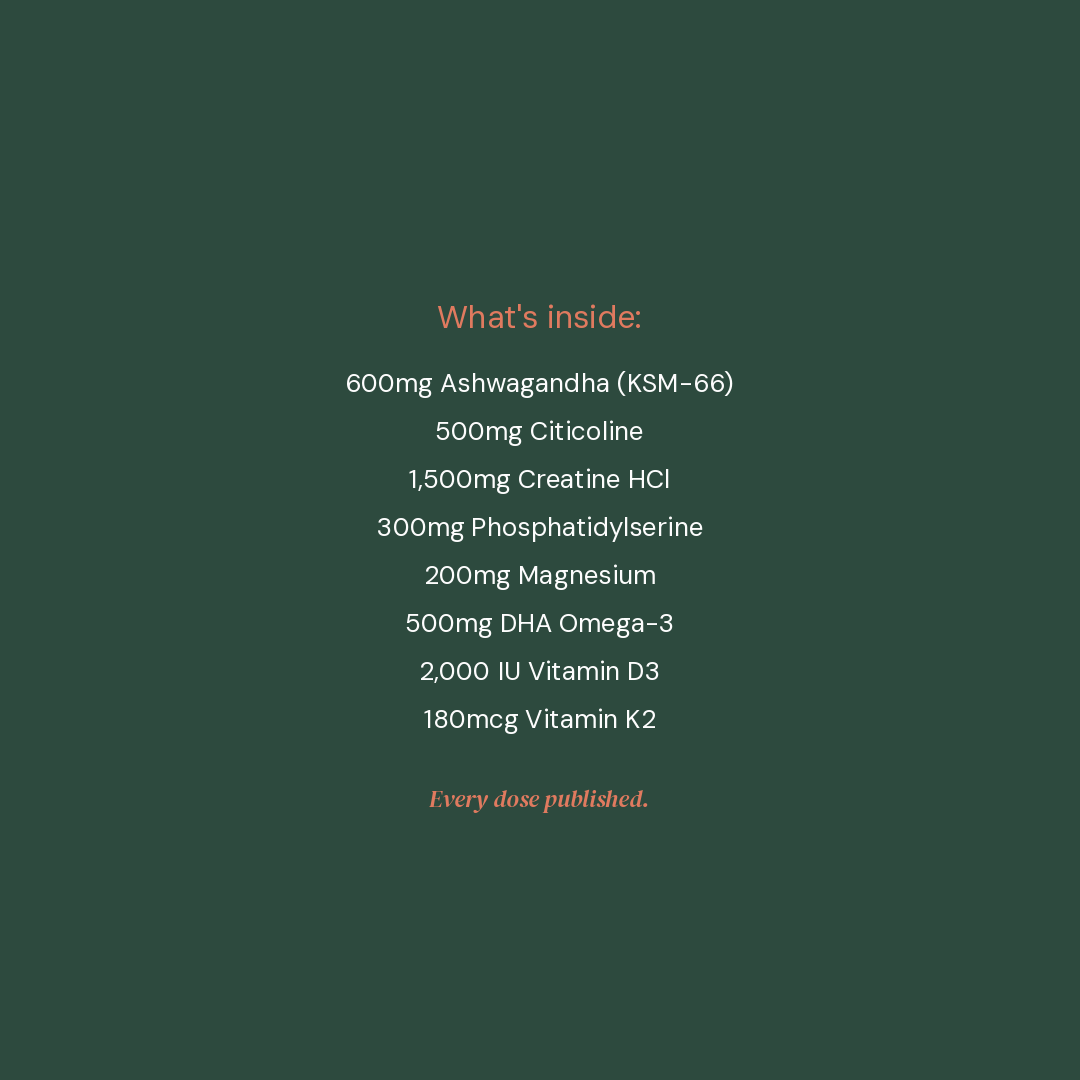
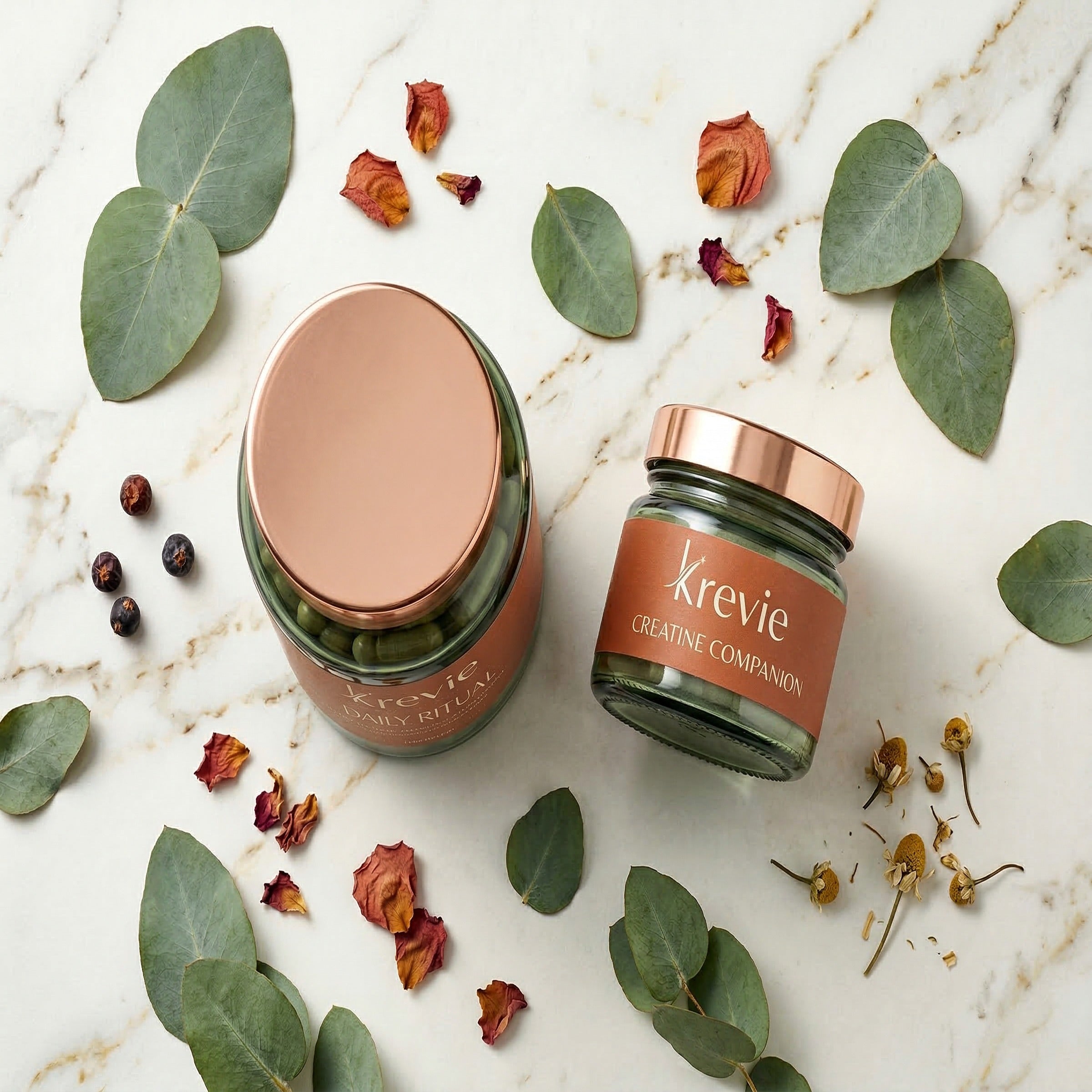
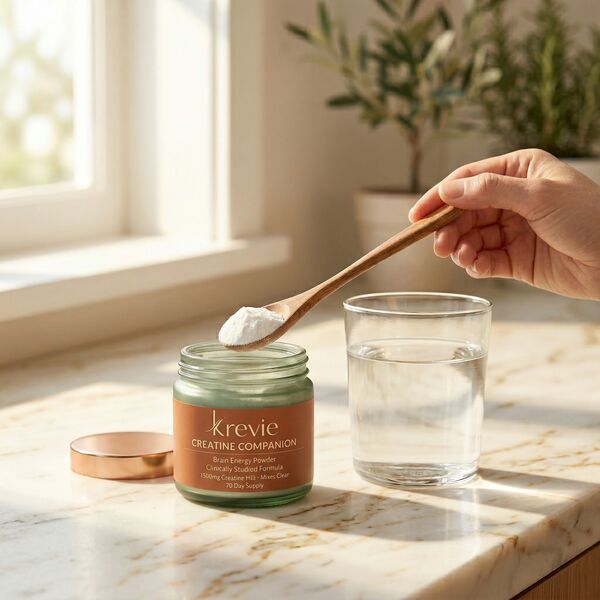
The Krevie Routine combines The Foundation (citicoline (CDP-choline) 500 mg, French maritime pine bark extract 200 mg, saffron extract 28 mg, vitamin D3 2,000 IU, vitamin K2 MK-7 100 mcg) with Creatine Companion (creatine HCl 1,500 mg) — each ingredient named, dosed, and sourced to match its primary trial. Creatine Companion provides 1,500 mg of creatine hydrochloride per daily serving — the medium-dose arm of the CONCRET-MENOPA trial, the only double-blind, placebo-controlled RCT of creatine HCl in perimenopausal and menopausal women published to date.
The Foundation's citicoline dose of 500 mg matches the Nakazaki et al. 2021 RCT exactly. The saffron extract dose of 28 mg is the minimum effective dose established by the Kell et al. 2017 trial — where 22 mg was insufficient and 28 mg was not. The French maritime pine bark extract dose of 200 mg is at the upper range of published cognitive research, not at the sub-threshold levels common in multi-ingredient products.
If the question is "are any supplements actually real?" — the honest answer is that some ingredients have better evidence than others, and for all of them, dose is not a detail. Dose is the mechanism.
Frequently asked questions
- Why don't most menopause supplements work?
- The two most common clinical explanations are underdosing and ingredient selection. Underdosing means the product contains an ingredient at a dose too small to replicate the conditions of any published trial — sometimes as low as 5–10% of the studied amount. Ingredient selection failure means the formula was built around ingredients with marketing momentum (black cohosh, B vitamins, red clover) rather than the ingredients with the strongest published evidence for measurable outcomes in this specific population (citicoline, creatine HCl, French maritime pine bark extract, standardised saffron extract). Both problems can apply to the same product simultaneously.
- What is "fairy dusting" in supplement formulation?
- "Fairy dusting" is the practice of including an ingredient at a dose so small it is functionally inert — present on the label for marketing purposes rather than physiological ones. Because there is no regulatory requirement in the UK or US that a supplement dose matches the dose used in clinical trials, a product can truthfully list an expensive, well-researched ingredient at 1–5% of its studied dose. The label is accurate. The outcome is indistinguishable from that of a product containing nothing.
- Does black cohosh actually work?
- The evidence is genuinely mixed. A Cochrane systematic review by Leach and Moore (2012) of 16 RCTs in 2,027 women found insufficient evidence compared to placebo. More recent reviews, including a 2022 Spanish Menopause Society statement, found a signal in favour of the isopropanolic extract at 40 mg/day. The honest summary: there is a published signal, it is extract-specific and dose-dependent, and it addresses one dimension only. Most commercial products neither specify the isopropanolic extract nor verify the dose — making comparison with the positive trial evidence impossible.
- What is the evidence for creatine in this context?
- The CONCRET-MENOPA trial (Korovljev et al., 2026, PMID 40854087) is the most directly relevant published data: a double-blind, placebo-controlled RCT in 36 perimenopausal and menopausal women, 8 weeks. The 1,500 mg/day creatine HCl group showed a 6.6% improvement in reaction time versus 1.2% in placebo (p < 0.01) and a 16.4% increase in frontal brain creatine concentrations versus 0.9% in placebo (p < 0.01). Creatine works via energy metabolism — increasing the availability of phosphocreatine for ATP resynthesis in the brain — not through hormonal pathways.
- How do I check whether a supplement's dose matches the research?
- Go to PubMed (pubmed.ncbi.nlm.nih.gov) and search the ingredient name plus "randomised controlled trial". Find the most rigorous published trial for that ingredient in a relevant population. Note the dose used in the treatment arm. Compare it to the dose on the supplement label. If the label dose is below 50% of the studied dose — or if the ingredient is inside a proprietary blend where the individual dose is unknown — the product cannot replicate the conditions under which the research found its results.
Further reading
- Proprietary blends, junk forms, and red flags: what to avoid when buying supplements
- How to read a supplement label: the 7-point checklist and red/green flag guide
- The Krevie science page: full study references for every ingredient in The Krevie Routine
Food supplements are not a substitute for a varied, balanced diet and a healthy lifestyle. Do not exceed the recommended daily dose. Always speak to your GP if you are taking medication or have a medical condition.

Leave a comment
This site is protected by hCaptcha and the hCaptcha Privacy Policy and Terms of Service apply.