Creatine HCl vs monohydrate: what the CONCRET-MENOPA trial actually measured
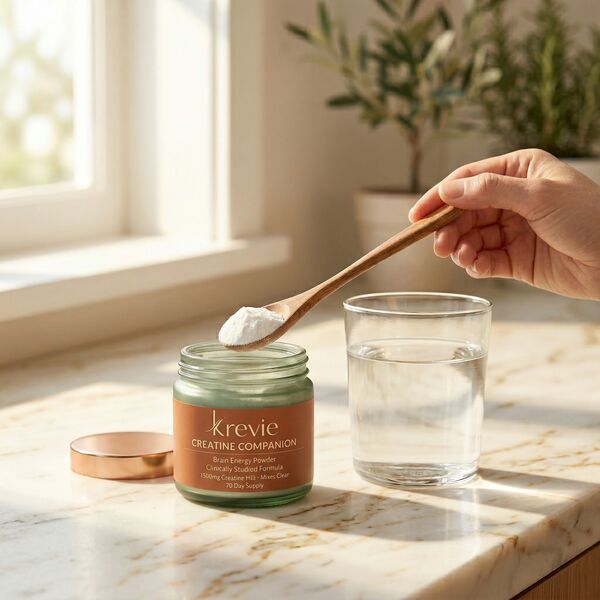
The question women most often ask once they decide to try creatine is not "should I take it?" — it is "is creatine HCl the same as creatine monohydrate, and does it matter which one I use?" It does matter, and not just in the way supplement marketing usually frames it. The CONCRET-MENOPA trial — the only published RCT to test creatine specifically in perimenopausal and menopausal women — used creatine hydrochloride at 1,500 mg per day, not monohydrate at 5 g. That is Krevie's dose and that is Krevie's form. This article explains what the chemistry difference actually is, why it affects the dose needed for daily use, and — because it is the most-searched concern about creatine among women — what actually happens on the scales.
What is creatine?
Creatine is a naturally occurring nitrogenous compound synthesised from the amino acids arginine, glycine, and methionine, primarily in the liver and kidneys. Once in cells, it combines with a phosphate group to form phosphocreatine (PCr). During high-demand tasks — intense muscular contractions or cognitively demanding work — PCr donates its phosphate to adenosine diphosphate (ADP) to regenerate adenosine triphosphate (ATP) at a rate approximately 12 times faster than oxidative phosphorylation. In the brain, this phosphocreatine buffer sustains local ATP availability during periods of elevated neural activity.
Dietary creatine comes predominantly from red meat and fish. Women who do not eat meat have measurably lower brain creatine levels than omnivores. The body synthesises approximately 1–2 g of creatine per day endogenously, but this is not sufficient to saturate muscle or brain creatine stores to the concentrations associated with the measurable outcomes in research.
What HCl chemistry actually changes
Creatine monohydrate is creatine bound to a single water molecule. In this form, creatine is only sparingly soluble in water — approximately 14 g will fully dissolve in one litre of water at room temperature. This means a 5 g dose of monohydrate requires a substantial volume of liquid to dissolve completely. Incomplete dissolution is the mechanism behind the gritty texture and gastrointestinal discomfort some people associate with monohydrate, particularly at loading-phase doses of 20 g per day.
Creatine hydrochloride is creatine bonded to a hydrochloric acid molecule — technically a hydrochloride salt of creatine, the same approach used in many pharmaceutical compounds to improve solubility. The difference in solubility is substantial: laboratory measurements put creatine HCl at approximately 41 times more soluble in water than creatine monohydrate. Where you need a litre of water to dissolve 14 g of monohydrate, creatine HCl dissolves completely in a fraction of that volume.
Why does this matter? Three reasons:
- Daily compliance. A 1,500 mg dose of creatine HCl dissolves fully in a small glass of water, juice, or a smoothie with no gritty residue and no requirement for specific mixing temperatures or large fluid volumes. Compliance with a supplement that mixes easily and causes no GI discomfort is higher than with one that doesn't — and in a 30-day supply context, compliance matters for accumulation.
- Lower effective dose without loading. The superior solubility of HCl means more complete absorption per milligram of creatine delivered, allowing equivalent muscular and neuronal creatine saturation at lower doses over time. The 1,500 mg dose in CONCRET-MENOPA was not an arbitrary number — it was chosen as the trial's medium-dose arm because it was expected to achieve meaningful creatine elevation without the osmotic loading effects of higher monohydrate doses.
- No loading phase required. The 20 g per day loading routine used to rapidly saturate creatine stores with monohydrate produces temporary scale weight increases (from intracellular water drawn into muscle with the creatine) and GI distress in some users. At 1,500 mg HCl daily, neither of these effects applies — there is no loading phase, and the accumulation happens steadily over time.
The water retention question — addressed directly
Women ask about creatine and the scale more than almost any other question. The concern — "I've heard creatine adds weight" — is the single most common barrier to starting. Here is what the research actually shows.
The water retention associated with creatine is real, but it is primarily a feature of high-dose monohydrate loading routines, not of maintenance-dose or low-dose use. The mechanism is osmotic: creatine is taken up into muscle cells by a sodium-dependent transporter, and water follows to maintain intracellular osmolality. At loading-phase doses of 20 g per day for 5–7 days, research has documented increases in total body water of approximately 1–2 litres in the first week, primarily intracellular — which corresponds to approximately 1–2 kg on the scales. This is not fat; it is intracellular fluid, and it reverses when supplementation stops.
At a daily maintenance dose of 1,500 mg — the CONCRET-MENOPA dose, the Krevie dose — this osmotic loading effect does not occur. The creatine accumulates gradually in muscle and brain tissue over weeks at a rate that does not trigger a measurable acute intracellular fluid shift. The CONCRET-MENOPA trial did not record changes in body mass as an adverse event. Several exercise science reviews confirm that at 3–5 g per day maintenance dosing without a loading phase, water retention is not a consistent finding in longer-duration trials; at 1,500 mg it is even less of a concern.
The ~1–2 kg scale increase some people report from creatine is a loading-phase phenomenon at 20 g/day monohydrate doses. It is intracellular water, not fat, and it reverses when creatine stops. At 1,500 mg creatine HCl daily — no loading phase — this effect does not apply. If you are concerned about weight, the Krevie dose is the one to use.
Why the dose is 1,500 mg, not 5 g
The default "take 5 g creatine" recommendation comes from sports performance research — specifically, from monohydrate loading and maintenance regimens optimised for muscular creatine saturation and resistance training outcomes in athletic populations. Most of those trials were conducted in men. The 5 g figure is not a universal recommendation for all populations and all outcomes.
The CONCRET-MENOPA trial was designed differently. It tested three doses of creatine HCl — 750 mg, 1,500 mg, and 800 mg HCl plus creatine ethyl ester — against placebo in 36 perimenopausal and menopausal women over 8 weeks, with the primary outcomes being reaction time and frontal brain creatine concentration measured by magnetic resonance spectroscopy. The trial found that the 1,500 mg per day arm was the dose that produced statistically significant improvements in both endpoints. The 750 mg arm did not reach significance. There was no 5 g arm because the research question was not about loading muscle stores for athletics — it was about whether a lower clinical dose could measurably elevate brain creatine in this specific population.
Matching the trial dose to the Krevie dose is not a marketing decision — it is the only defensible formulation choice when the goal is to deliver what the research tested.
The research
A randomised controlled trial; 36 perimenopausal and menopausal women (mean age 50.1 ± 5.7 years). Four arms over 8 weeks: creatine HCl 750 mg/day; creatine HCl 1,500 mg/day; creatine HCl + ethyl ester 800 mg/day combined; placebo.
Reaction time: Medium-dose HCl (1,500 mg/day) produced a 6.6% improvement versus 1.2% in the placebo arm (p < 0.01). This is a directly measured cognitive performance metric — the time taken to respond to a stimulus under standardised conditions — not a self-report scale.
Frontal brain creatine: Measured by magnetic resonance spectroscopy. Medium-dose HCl showed a 16.4% increase in frontal brain creatine concentration versus 0.9% in the placebo arm (p < 0.01). This is the first trial to directly measure brain creatine change from creatine HCl supplementation in menopausal women.
Serum lipid profiles: Statistically significant favourable changes in the medium-dose HCl arm versus placebo (p < 0.05).
All interventions were well tolerated. No severe adverse effects were reported in any arm. Body weight was not identified as an adverse event.
A systematic review and meta-analysis of 16 RCTs; 492 participants aged 20.8–76.4 years. All studies used creatine monohydrate.
Memory: Significant positive effect (SMD = 0.31, 95% CI 0.18–0.44; p < 0.00001; I² = 21%). GRADE certainty: moderate.
Attention time: Significant reduction in time required to complete attention tasks (SMD = −0.31, 95% CI −0.58 to −0.03; p = 0.03).
Processing speed time: Significant reduction overall (SMD = −0.51, 95% CI −1.01 to −0.01; p = 0.04).
Sex-specific subgroup: In female participants, the processing speed effect was significant (SMD = −0.87, 95% CI −1.53 to −0.21; p = 0.01). In male participants, it was not (p = 0.29). This sex-stratified finding is notable for its practical implications: the evidence for processing speed effects from creatine is stronger in women than in men across the available trial literature.
HCl vs monohydrate: a direct comparison
| Property | Creatine Monohydrate | Creatine HCl |
|---|---|---|
| What it is | Creatine bound to a water molecule | Creatine bound to a hydrochloric acid molecule (a salt) |
| Solubility | ~14 g/L in water (sparingly soluble) | ~41× more soluble — dissolves fully at very low volumes |
| Typical research dose | 3–5 g/day maintenance; 20 g/day loading | 1,500 mg/day (CONCRET-MENOPA dose) |
| Loading phase | Optional — common in sports contexts | Not used at 1,500 mg |
| Water retention | 1–2 kg intracellular water during loading phase at 20 g/day | Not observed at 1,500 mg/day maintenance dose |
| GI tolerance | Can cause bloating at loading-phase doses | No GI adverse events at 1,500 mg in CONCRET-MENOPA |
| Evidence in menopausal women | Not directly tested in menopausal women for brain outcomes | CONCRET-MENOPA (Korovljev 2025): reaction time and brain creatine in peri/menopausal women |
What this research does and does not say
The CONCRET-MENOPA trial measured reaction time using a standardised cognitive test under controlled laboratory conditions. A 6.6% improvement is a measurable difference in a specific, objective metric — it is not a self-reported outcome and it is not a general claim about cognitive ability. Krevie references this finding precisely because it is what the study measured in the relevant population at the relevant dose.
The European Food Safety Authority reviewed the health claim "creatine supplementation improves cognitive function" and concluded that a cause-and-effect relationship has not been established for the general population. Krevie does not make that claim. Krevie describes what the CONCRET-MENOPA trial specifically measured — reaction time in perimenopausal and menopausal women taking 1,500 mg creatine HCl daily over 8 weeks — and links to the study for independent review. That is an important distinction.
Creatine is one of the most extensively studied nutritional supplements in human research history, with a safety profile established across decades of research. At the 1,500 mg dose used in Creatine Companion, the risk profile is benign. The only practical clinical note is that creatine supplementation raises serum creatinine — the metabolic breakdown product of creatine — which can produce a false-positive result for reduced kidney function on routine blood tests. If you are having kidney function tested, tell your GP or laboratory that you are supplementing with creatine.
How it's used in Krevie
Product: Creatine Companion
Form: Creatine hydrochloride (HCl)
Dose: 1,500 mg per serving (one scoop)
Pack: 45 g / 30 servings
One scoop per day, mixed into water, juice, or a smoothie. No loading phase. No gritty texture. The 1,500 mg dose matches the medium-dose arm of the CONCRET-MENOPA trial — the arm that produced statistically significant improvements in reaction time (p < 0.01) and frontal brain creatine levels (p < 0.01) in perimenopausal and menopausal women. That is the only RCT that has tested creatine HCl at this dose specifically in this population.
Frequently asked questions
Is creatine HCl the same as creatine monohydrate?
No. Both contain the same creatine molecule, but the form differs: monohydrate is creatine bound to a water molecule; HCl is creatine bound to a hydrochloric acid molecule. The practical difference is solubility — creatine HCl is approximately 41 times more soluble in water than monohydrate, which means it dissolves fully at a much lower dose and with less fluid. This allows an effective dose of 1,500 mg HCl to deliver meaningful creatine saturation without the loading-phase doses (20 g/day) used in monohydrate regimens. The CONCRET-MENOPA trial used creatine HCl at 1,500 mg specifically; Krevie matches that trial's conditions.
Does creatine change scale weight?
The scale increase some people experience from creatine is intracellular water drawn into muscle tissue, not fat. It is primarily a loading-phase phenomenon at 20 g/day monohydrate doses — research documents approximately 1–2 kg of intracellular water shift during the first week of a loading phase. At a daily maintenance dose of 1,500 mg creatine HCl (the Krevie dose), no loading phase is used and this osmotic water-loading effect does not apply. The CONCRET-MENOPA trial did not record body mass changes as an adverse event. If your concern is scale weight, the CONCRET-MENOPA dose and form is the one to choose.
What is the best creatine form for women?
The only creatine form tested specifically in perimenopausal and menopausal women for brain outcomes is creatine HCl, at 1,500 mg per day, in the CONCRET-MENOPA trial (Korovljev et al. 2025). The only form tested in the broader meta-analysis literature on cognition is creatine monohydrate. If brain-related outcomes are the goal and you are in or approaching the menopause life stage, creatine HCl at 1,500 mg is the best-evidenced choice based on the available trial data. If your goal is muscle strength and performance, the monohydrate evidence base is far deeper and monohydrate at 3–5 g/day is well-supported.
Why is Krevie's creatine dose 1,500 mg when everyone says take 5 g?
The "take 5 g" convention comes from sports performance research in predominantly male athletic populations using creatine monohydrate. The CONCRET-MENOPA trial was designed for a different population and a different outcome: reaction time and brain creatine concentration in perimenopausal and menopausal women. It tested creatine HCl, not monohydrate, and it found that 1,500 mg per day — not 5,000 mg — produced statistically significant improvements in both its primary endpoints. Krevie uses the dose from the relevant trial, not the dose from an unrelated one.
Can vegetarians and vegans take Creatine Companion?
Yes. Creatine Companion contains only synthetically produced creatine hydrochloride — no animal-derived raw materials are involved in its manufacture. People who do not eat meat or fish consistently show lower baseline creatine and brain creatine levels than omnivores in population studies, because dietary creatine comes almost exclusively from animal-source foods. This means the measurable increment from supplementation at 1,500 mg/day may be larger in vegetarians and vegans than in those with adequate dietary intake.
Further reading
Food supplements are not a substitute for a varied, balanced diet and a healthy lifestyle. Do not exceed the recommended daily dose. Always speak to your GP if you are taking medication or have a medical condition.

Leave a comment
This site is protected by hCaptcha and the hCaptcha Privacy Policy and Terms of Service apply.